
Part I: The Religion Itself
Chapter 1
Origins of Christianity: From Jewish Sect to World Religion
A Note on Tone
This series — the World Religions Explorer — is written without political deference, institutional courtesy, or cultural timidity. Every religion examined here is treated as a human phenomenon: historical, sociological, psychological, and above all, testable against evidence. This is not written in hostility toward believers. It is written in the conviction that ideas — all ideas — deserve rigorous scrutiny, and that the most respectful thing one can do with a set of beliefs is to take them seriously enough to examine them honestly. Readers who require that their beliefs be treated as beyond question will find this series uncomfortable. That is intentional.
Chapter 1: Origins of Christianity — From Jewish Sect to World Religion
The World That Produced Jesus
Christianity did not emerge from a vacuum. It was born in the eastern Roman Empire, in a province called Judaea, during one of the most politically turbulent periods in Jewish history. To understand what Christianity is, one must first understand what it grew out of.
First-century Judaea was a society under occupation. Rome had controlled the region since 63 BCE, when the general Pompey marched into Jerusalem and desecrated the Temple by entering the Holy of Holies — an act of symbolic violence that resonated through Jewish consciousness for generations. Roman rule was administered through client kings, the most famous of whom was Herod the Great (37–4 BCE), a man of extraordinary architectural ambition and extraordinary brutality, who rebuilt the Jerusalem Temple on a magnificent scale while maintaining his position through terror, espionage, and the murder of family members he suspected of disloyalty.
Jewish society under Roman rule was fractured into competing religious and political factions. The Pharisees were the dominant popular movement, deeply committed to Torah observance and the development of an oral interpretive tradition that would eventually become the Talmud. The Sadducees were the priestly aristocracy, controlling the Temple and its economy, theologically conservative, and politically accommodationist toward Rome. The Zealots were revolutionary nationalists who believed armed resistance to Rome was a religious obligation. The Essenes — the community associated with the Dead Sea Scrolls — had withdrawn from mainstream Jewish society to await a cosmic apocalyptic intervention. And scattered throughout were smaller movements: healers, prophets, wisdom teachers, exorcists, and apocalyptic preachers, all competing for the spiritual allegiance of a people desperate for hope, meaning, and liberation.
It was into this world — already saturated with messianic expectation, apocalyptic theology, and popular religious ferment — that Jesus of Nazareth was born, preached, and died.
The Historical Jesus: What We Can Reasonably Establish
The question of the historical Jesus is one of the most contentious in scholarship, generating a library of books, a spectrum of positions, and a great deal of heat alongside the light. The range of scholarly positions runs from those who argue Jesus was a fully mythological figure invented wholesale by early Christian communities, to those who treat the Gospel accounts as essentially reliable historical records. Neither extreme commands broad scholarly support.
The mainstream critical consensus — held by the majority of historians who specialise in Christian origins, including secular scholars with no theological stake in the answer — is that a Jewish preacher named Jesus existed in first-century Palestine, was associated with John the Baptist, gathered disciples, taught a message combining apocalyptic urgency with ethical radicalism, and was crucified by Roman authorities under Pontius Pilate, probably around 30 CE.
This consensus rests on several evidential pillars:
Non-Christian sources. The Roman historian Tacitus, writing around 116 CE, mentions Christians in the context of the Great Fire of Rome (64 CE): "Christus, from whom the name had its origin, suffered the extreme penalty during the reign of Tiberius at the hands of one of our procurators, Pontius Pilatus." Tacitus is hostile to Christianity and has no interest in validating its claims — which is precisely why his reference is evidentially significant. Similarly, the Jewish historian Josephus, writing in the 90s CE, includes a reference to "James the brother of Jesus who was called Christ" — almost universally accepted as authentic — and a longer passage about Jesus (the Testimonium Flavianum) that has clearly been interpolated by later Christian editors but is widely believed to contain an authentic Josephan core.
The criterion of embarrassment. Several features of the Gospel tradition are awkward or counterproductive from a theological standpoint, which suggests they were preserved because they were remembered rather than invented. Jesus being baptised by John — which implies John's superiority and Jesus's need for purification — is the classic example. Early Christians developed elaborate theological justifications for this episode rather than simply removing it, which strongly suggests it happened.
The diversity of early tradition. The Gospels, Paul's letters, and other early Christian texts preserve multiple, sometimes contradictory traditions. This diversity is the fingerprint of real historical memory being processed and interpreted by different communities, rather than a single invented narrative.
What the historical evidence does not establish — and cannot establish — is the theological content of Christianity: the divine nature of Jesus, the resurrection, the miracles, the pre-existence, the atonement. These belong to the realm of faith claims, which will be assessed in Part III of this book.
John the Baptist and the Apocalyptic Context
Any account of Jesus that ignores John the Baptist misses the theological headwaters of the entire movement. John was an ascetic prophet operating in the Judaean wilderness, preaching a message of imminent divine judgment and calling people to repentance sealed by ritual immersion in the Jordan River. His message was urgently apocalyptic: the axe was already at the root of the tree; the winnowing fork was in the thresher's hand; the time for comfortable religion was over.
Jesus was baptised by John, almost certainly as a disciple. After John's execution by Herod Antipas — the tetrarch of Galilee, who arrested John for publicly criticising his marriage to his brother's former wife — Jesus began his own public ministry. The continuity is significant. Jesus inherited John's apocalyptic urgency and his confrontational posture toward religious complacency, while developing a distinct emphasis on the present availability of God's Kingdom to the marginalised, the sick, and the sinful.
This apocalyptic foundation is crucial to understanding early Christianity accurately. Jesus, as most critical scholars now conclude, was an apocalyptic preacher who believed the end of the current age was imminent — within the lifetime of his audience. This conclusion, uncomfortable for many Christians, follows from a straightforward reading of the Gospel texts themselves: "Truly I tell you, this generation will not pass away until all these things have taken place" (Mark 13:30); "There are some standing here who will not taste death before they see the Son of Man coming in his kingdom" (Matthew 16:28). The Kingdom did not arrive within that generation. This is the first of many evidential problems that will be examined in Part III.
The Ministry: Galilee and Jerusalem
Jesus's public ministry, by scholarly consensus, lasted somewhere between one and three years. The Synoptic Gospels (Matthew, Mark, Luke) suggest a single year with a single visit to Jerusalem; John's Gospel suggests multiple Passover visits and a three-year ministry. The discrepancy is one of many that will be addressed in Part II.
His base of operations was Galilee, a region in the northern part of the province, far from the religious and political centre of Jerusalem. Galilee was economically marginal, culturally mixed, and socially volatile. Jesus operated primarily among fishing communities on the shores of the Sea of Galilee — Capernaum, Bethsaida, Chorazin — and in the small villages of the surrounding hill country.
The content of his teaching, as reconstructed from the earliest sources, had several distinctive emphases:
The Kingdom of God was his central proclamation. This was not primarily a reference to a heavenly afterlife but to a transformation of the present world order — a divine intervention that would overturn existing hierarchies, vindicate the poor, and establish justice. The precise nature of this Kingdom — whether present, future, or both — has been the subject of intense scholarly debate for over a century.
Reversal of social hierarchies. Jesus's teaching consistently privileged the poor, the sick, women, tax collectors, prostitutes, and other socially marginalised figures over the religious establishment. The parable of the Prodigal Son, the encounter with Zacchaeus, the healing of lepers, the conversations with Samaritan and gentile women — all reflect a persistent pattern of boundary-crossing in favour of the excluded.
Ethical intensification. The Sermon on the Mount (Matthew 5–7) represents a radicalisation of Torah ethics: not just refraining from murder but eliminating the hatred that leads to it; not just avoiding adultery but purging the objectifying gaze. Whether this represents a rejection of Torah, an intensification of it, or a creative reinterpretation remains disputed.
Confrontation with religious authority. The Gospels consistently depict Jesus in conflict with Pharisees and scribes over questions of Sabbath observance, purity laws, and table fellowship. The nature and intensity of this conflict has been significantly shaped by later anti-Jewish polemic in the Gospels themselves — Matthew's Gospel in particular reflects a bitter intra-Jewish dispute decades after Jesus's death — but some historical confrontation is likely genuine.
The Crucifixion
All sources agree on the basic fact: Jesus was crucified. Crucifixion was a Roman method of execution reserved for slaves, rebels, and those judged to be enemies of the state. It was designed not merely to kill but to humiliate — to display the victim publicly as a deterrent, to strip away dignity, to enforce Roman domination.
The theological problem this created for Jesus's followers was enormous. In Jewish tradition, one who died on a tree was under God's curse (Deuteronomy 21:23). A crucified messiah was, from a Jewish perspective, a contradiction in terms — a demonstration that the candidate had failed. This is why Paul describes the crucified Christ as "a stumbling block to Jews and foolishness to Gentiles" (1 Corinthians 1:23). No one would have invented a crucified messiah. The crucifixion is almost certainly historical.
The precise charge on which Jesus was executed is stated in the Gospels as a placard on the cross: "King of the Jews." This was a political charge — sedition, the claim to royal authority in Roman-occupied Judaea. The responsibility for the execution in the Gospels is distributed between Roman and Jewish authorities in ways that reflect the political circumstances of later Gospel composition rather than historical precision. Pilate would have ordered the execution; Roman soldiers would have carried it out. The Jewish leadership's involvement remains historically uncertain and theologically fraught, having been used for centuries as justification for antisemitic violence.
The Resurrection Claim and the Birth of the Movement
Whatever happened after the crucifixion, something dramatic clearly occurred. The disciples — who had fled and hidden after Jesus's arrest — regrouped within weeks and began publicly proclaiming that Jesus had been raised from the dead. This proclamation, begun in Jerusalem within months of the crucifixion, is the foundation on which the entire edifice of Christianity rests.
Paul's letter to the Corinthians, written around 54 CE — within 25 years of the crucifixion — provides the earliest written testimony: "he appeared to Cephas, then to the twelve. Then he appeared to more than five hundred brothers and sisters at one time... Then he appeared to James, then to all the apostles. Last of all, as to someone untimely born, he appeared also to me." (1 Corinthians 15:5–8).
This is early testimony, and it is testimony to experiences of the risen Jesus — visions, encounters, appearances. What precisely these experiences were, what caused them, and what they tell us is the central question of Christian origins. It is a question that will be examined in full in Part III.
What can be said historically is this: the disciples became convinced — at significant personal cost — that Jesus was alive and vindicated by God. This conviction drove them to preach publicly in Jerusalem, to accept persecution, and eventually to spread their message across the Roman world. Within three centuries, that message had become the official religion of the Empire.
From Movement to Institution
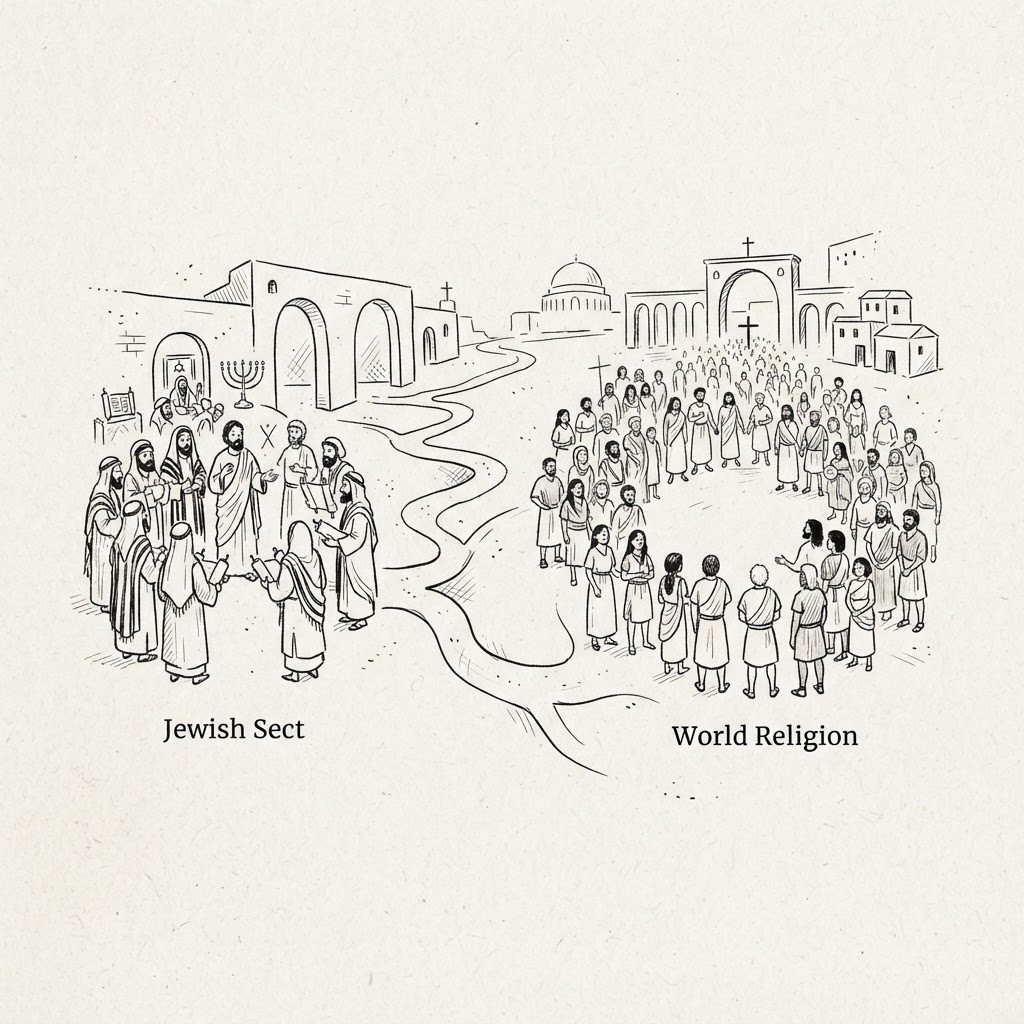
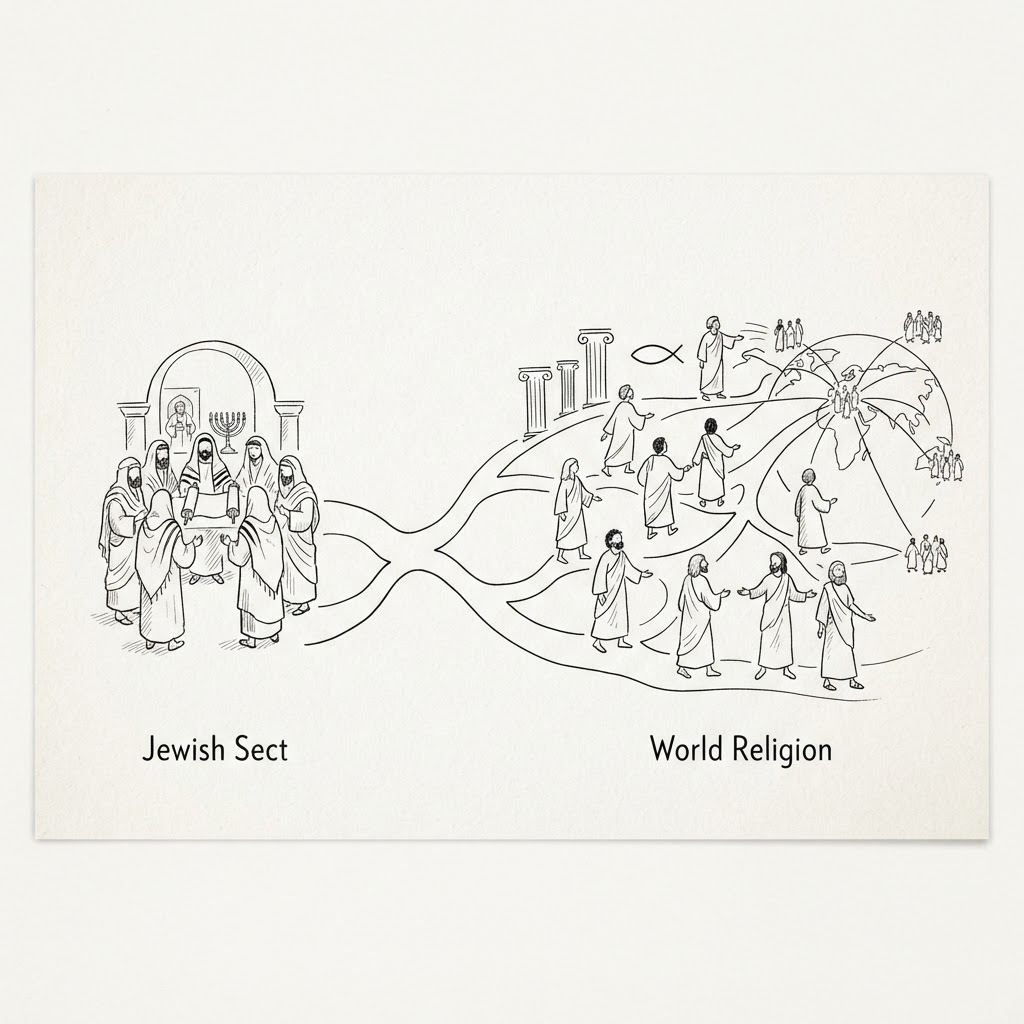
The transformation of a small Jewish apocalyptic sect in first-century Palestine into the dominant religion of Western civilisation is one of the most remarkable stories in human history. Understanding how it happened is essential to evaluating what Christianity is.
The key figures in this transformation are Paul of Tarsus, the anonymous authors of the four Gospels, and the institutional architects of what became the Catholic Church.
Paul (c. 5–64 CE) never met the living Jesus, but his letters — written in the 50s CE, before any of the Gospels — represent the earliest surviving Christian theological documents. Paul's version of Christianity differs in significant ways from the Synoptic Gospel tradition: it is less concerned with Jesus's ethical teachings and profoundly focused on the meaning of his death and resurrection. Paul developed the theological framework — justification by faith, the new covenant, the universal scope of salvation — that would shape Western Christianity.
The Gospels were written between approximately 70 CE (Mark) and 100–110 CE (John). They are not eyewitness accounts. Mark, the earliest, was written forty years after the crucifixion by an unknown author who may have had access to earlier written sources and oral traditions. Matthew and Luke used Mark as a primary source, adding material from a now-lost sayings collection scholars call Q, plus their own distinct traditions. John is theologically the most developed and historically the most problematic.
The institutional church emerged gradually from the second century onward, as diverse early Christian communities were brought under increasing central coordination. The Council of Nicaea (325 CE), convened by the Emperor Constantine, was a watershed: it produced the Nicene Creed, established the orthodox doctrine of Christ's divine nature, and formally aligned Christianity with imperial power. The church that emerged from this process was a very different institution from the movement Jesus launched.
What Christianity Teaches: The Core Doctrines
By the time Christian doctrine crystallised into its classical form — through centuries of councils, creeds, and theological dispute — it contained the following core claims:
God. Christianity is monotheistic, teaching that there is one God who is the creator and sustainer of the universe. This God is personal — capable of relationship, action, and emotion — and good. Unlike the philosophical Absolute of Greek thought, the Christian God enters history, speaks, and intervenes.
The Trinity. The most distinctive and theologically complex Christian doctrine holds that the one God exists in three persons: Father, Son, and Holy Spirit. Each person is fully God; there are not three gods but one. This doctrine is not explicitly stated in the New Testament but was developed through centuries of theological controversy and definitively formulated at the Councils of Nicaea (325 CE) and Constantinople (381 CE).
Jesus Christ. Christianity teaches that Jesus was both fully God and fully human — the second person of the Trinity incarnate. This is the doctrine of the Incarnation. Jesus is understood as the fulfilment of Jewish messianic prophecy, the definitive revelation of God's character, and the agent of salvation.
The Atonement. Christianity teaches that humanity is separated from God by sin — a moral condition of rebellion and failure that humans cannot remedy by their own efforts. Jesus's death on the cross is understood as an atoning sacrifice: somehow, in his death, the problem of sin is resolved and the relationship between God and humanity is restored. The precise mechanism has been theorised in multiple ways: substitutionary atonement (Jesus bore the punishment humans deserved), moral influence theory (Jesus's death demonstrates God's love and draws humans to repentance), Christus Victor (Jesus's death and resurrection defeated the powers of sin and death). No single theory has been universally accepted.
Resurrection and Eternal Life. Christianity teaches that Jesus rose bodily from the dead on the third day after his crucifixion, and that this resurrection is both the vindication of his claims and the first instance of a general resurrection that all believers will share. Life after death — in a resurrected body, in the presence of God — is central to Christian hope.
Scripture. Christianity holds the Bible to be in some sense the Word of God — divinely inspired and authoritative. The precise nature of this inspiration and authority has been hotly contested: from strict inerrancy (every word is literally true and factually accurate) to loose inspiration (the human authors wrote authentically, guided by the Spirit, but not dictated to). The Biblical canon — which books are included — was itself a contested process that took centuries to resolve.
The Church. Christianity is not merely a set of individual beliefs but a communal practice. The church — the assembled community of believers — is understood as the Body of Christ, the ongoing presence of Jesus in the world.
Sacraments. Most Christian traditions practice sacramental rites — outward physical actions that convey inward spiritual realities. Baptism and the Eucharist (or Communion, or the Lord's Supper) are universal; Catholic and Orthodox traditions recognise five additional sacraments.
Christianity's Reach and Diversity
Christianity today claims approximately 2.4 billion adherents — roughly 31% of the global population — making it the world's largest religion. It encompasses an extraordinary diversity of traditions, cultures, and theological positions.
The three major divisions are:
Roman Catholicism (approximately 1.3 billion): The largest single Christian body, maintaining apostolic succession, the authority of the Pope, seven sacraments, the veneration of saints, and a complex tradition of doctrinal development through Church councils.
Protestantism (approximately 800 million, across thousands of denominations): Originating in the sixteenth-century Reformation, Protestantism rejected papal authority, reduced the sacraments to two, and elevated Scripture as the sole or primary authority (sola scriptura). The Protestant world ranges from Lutheran and Reformed traditions with sophisticated theological systems to Pentecostal and charismatic movements emphasising direct spiritual experience.
Eastern Orthodoxy (approximately 260 million): The churches of Eastern Europe, Russia, and the Middle East that broke from Rome in 1054. Orthodoxy emphasises the mystical dimensions of Christian faith, the centrality of the Liturgy, and the continuity of apostolic tradition.
Beyond these major families are Anglicanism, Oriental Orthodoxy, independent evangelical movements, and numerous smaller groups — Jehovah's Witnesses, Mormons, Seventh-day Adventists — that claim Christian identity while departing significantly from classical doctrine.
This diversity is itself telling: if Christianity's divine source provided unambiguous guidance, two thousand years of schism, heresy trials, religious wars, and doctrinal controversy would be difficult to explain. The incoherence of the tradition is not merely an academic observation — it is evidence that will be returned to in Part III.
Conclusion
Christianity began as one small Jewish movement among many in the turbulent world of first-century Palestine. Through a confluence of historical accident, theological creativity, political patronage, and genuine spiritual hunger, it became the dominant religion of Western civilisation. To understand what it claims, what the evidence for those claims actually is, and what happens when those claims are subjected to the same scrutiny we apply to all other knowledge claims — that is the project of this book.
The religion's story has been told many times, by devotees and critics alike. This account aims to be something rarer: honest about what the evidence shows, fair about what it does not show, and unflinching about the conclusions to which a careful, evidence-based assessment ultimately leads.
What follows is that assessment.